
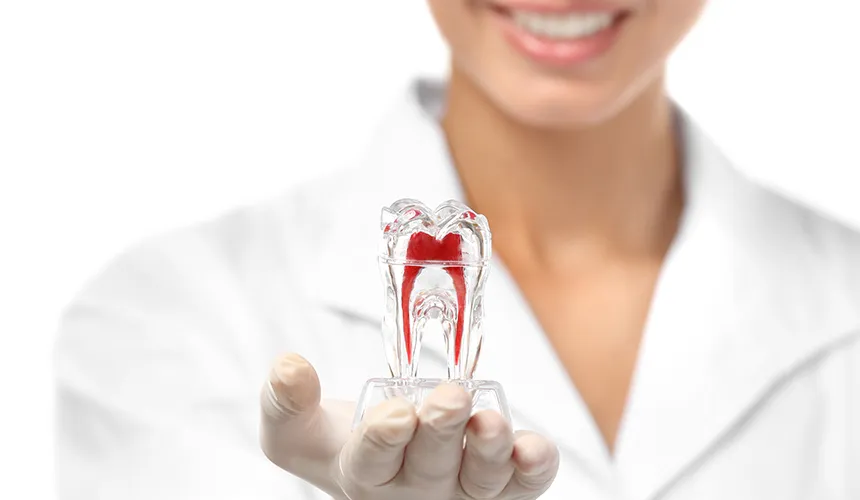
Endodontics (root canal treatment) is the specialty concerned with the pulp, the blood vessel and nerve tissue inside the tooth. It is needed when the pulp becomes infected due to deep decay, cracks or trauma. The infected tissue is removed, the canals are cleaned and filled, and the tooth is restored with a filling or crown.
- May be needed for throbbing night pain, lasting sensitivity or gum swelling.
- Diagnosis is made by X-ray; treatment is done under local anaesthesia.
- Canals are cleaned, disinfected and sealed with gutta-percha.
- Mild sensitivity in the first few days after treatment is normal.
Endodontics (Root Canal Treatment)
One of the most important branches of dentistry, which prevents tooth loss and allows natural teeth to remain in the mouth, is Endodontics – known to most people as Root Canal Treatment. In the past, teeth with severe pain or inflammation were usually extracted; today, thanks to modern endodontic methods, it is possible to keep using these teeth healthily for many years.
What Is Endodontics?
Endodontics is the specialty concerned with the “pulp” layer inside the tooth, which consists of blood vessels and nerves. Endodontic treatment is needed when this living tissue – located beneath the hard outer enamel, nourishing the tooth and giving it sensation – becomes infected due to deep decay, cracks or trauma.
When Is Root Canal Treatment Needed?
If you notice one or more of the following symptoms in your tooth, it is advisable to see an endodontic specialist (endodontist):
Constant and Severe Pain: Throbbing pain, especially pain that worsens at night.
Prolonged Sensitivity: Excessive sensitivity to hot or cold foods and drinks that does not go away.
Swelling of the Gums: Pimple-like formations (fistula) or swelling of the gums near the tooth root.
Darkening of the Tooth: Greyish discolouration of the tooth due to trauma or internal infection.
Pain When Chewing: Sharp pain when pressure is applied to the tooth.
How Is Root Canal Treatment Performed? (Step-by-Step Process)
Thanks to modern technology and local anaesthesia, root canal treatment is no longer a procedure to be feared and has become as comfortable as having a filling.
Examination and Diagnosis: An X-ray of the tooth is taken to examine the root structure and the spread of infection.
Anaesthesia: The area to be treated is numbed so that the patient feels no pain at all.
Cleaning: The decayed tissue in the tooth is removed and the pulp chamber is accessed. The infected nerve and vessel tissue is removed from the root canals.
Shaping and Disinfection: The root canals are widened with special instruments and irrigated with solutions to eliminate bacteria.
Filling: The cleaned canals are sealed with a special biocompatible filling material (gutta-percha) to ensure a tight seal.
Restoration: The upper part of the tooth is restored with a filling or a crown, depending on the loss of tooth structure, returning it to function.
Common Misconceptions About Root Canal Treatment Myth: Root canal treatment is a very painful procedure. Fact: Thanks to the local anaesthesia given during treatment, the patient feels nothing. On the contrary, root canal treatment is performed to relieve existing severe pain. Myth: A tooth that has had root canal treatment is “dead”, so it will break right away. Fact: A tooth whose nerve has been removed can become more brittle because it no longer receives nourishment; however, with a proper restoration on top (for example, a porcelain crown), this tooth can remain in the mouth for a lifetime. What to Keep in Mind After Treatment In the first few days after root canal treatment, mild sensitivity is normal. To speed up the process: Diet: Do not eat until the numbness wears off. Avoid chewing very hard foods on that side until the treatment is complete. Pain Control: The mild painkillers recommended by your dentist will keep you comfortable during this period. Hygiene: Take care to brush your teeth and use dental floss. Condition Before Root Canal Treatment After Root Canal Treatment Pain Level Severe / Constant None / Mild Sensitivity Dental Health Infected / Risk of Loss Treated / Preserved Function Difficulty Chewing Normal Chewing Preserving your own tooth is always more advantageous than an artificial tooth (implant or bridge). Do not ignore your toothache – protect your natural smile with endodontics.
What Is Pulp Capping?
It is applied during the treatment of deep decay when the pulp (the part of the tooth containing the nerves and blood vessels) is exposed at a very small point, or when the protective tissue over it has become very thin. Before filling materials are placed in the tooth, tissue-friendly, healing materials are used to protect the pulp.
Who can have pulp capping?
- Patients whose pulp has not lost its vitality
- Patients with good oral hygiene
- If no decay-affected area remains around the exposed nerve tissue
- If the exposed nerve tissue is very small
- Patients with more than one exposed area of nerve tissue
- Patients without diabetes
- Patients without a systemic blood disorder (leukaemia, haemophilia,…)
- Patients without a metabolic disorder that impairs blood circulation
Pulpotomy (Amputation)
What is a pulpotomy?
In cases where the pulp tissue has been exposed due to trauma or decay, it is the removal of the pulp tissue in the visible part of the tooth (coronal pulp) while leaving the living pulp tissue inside the root canals.
Who can have a pulpotomy?
- The pulp must not have lost its vitality.
- Oral hygiene must be good.
- There must be no infection in the pulp.
- The patient must not have diabetes.
- The patient must not have a systemic blood disorder (leukaemia, haemophilia,…)
- The patient must not have a metabolic disorder that impairs blood circulation.
Whitening of Root Canal Treated Teeth
What causes discolouration in teeth that have had root canal treatment?
● Materials used during root canal treatment
● Root canal filling materials
● Tissue remnants left inside the canal
● Reflection of pins and posts placed inside the tooth
● Amalgam fillings
Can discolouration of a tooth after root canal treatment be removed?
Discolouration can be removed with whitening agents placed inside the canal. In such cases, what determines the process is the cause of the discolouration. For non-vital (internal) bleaching to be performed, the root canal treatment must have been carried out successfully.
Frequently asked questions
Is root canal treatment painful?
Thanks to the local anaesthesia given during treatment, the patient feels nothing. On the contrary, root canal treatment is performed to relieve existing severe pain. Mild sensitivity in the first few days after treatment is normal.
Does a root-canal-treated tooth break easily?
A tooth whose nerve has been removed can become more brittle because it is no longer nourished. However, with a proper restoration on top, such as a porcelain crown, the tooth can remain in the mouth for life. Keeping your own tooth is always preferable to an artificial one.
What should I pay attention to after root canal treatment?
Do not eat until the numbness wears off, and avoid chewing very hard foods on that side until treatment is complete. Mild painkillers recommended by the dentist can be used, and you should keep brushing and flossing carefully.
Can discolouration after root canal treatment be removed?
Discolouration can be removed with bleaching agents placed inside the canal; the cause of the discolouration determines the process. For internal (devital) bleaching to be possible, the root canal treatment must have been performed successfully.