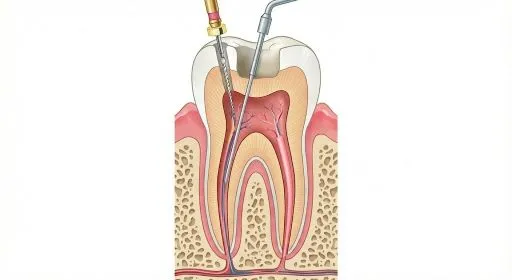
Root canal treatment (endodontics) cleans and disinfects the blood vessel and nerve bundle (pulp) inside the tooth, then seals it with special filling materials. It keeps the tooth in the mouth instead of extracting it when the pulp is damaged. Deep cavities, trauma, cracked teeth, advanced gum disease and repeated restorations are the main causes.
- Stages: infected tissue is removed, canals are shaped, disinfected and filled.
- The tooth is then restored with a filling or crown.
- Signs: lingering heat sensitivity, night pain and pain when chewing.
- Swollen gums or tooth discoloration can also be signs.
- With modern anesthesia, the procedure feels no different from a normal filling.
Root canal treatment can be described, in the simplest terms, as the “last stop where a tooth can be saved”. It is a treatment used to keep the tooth in the mouth instead of extracting it when the living tissue (pulp) at the center of the tooth is damaged.
🦷 What Is Root Canal Treatment?
Root canal treatment (endodontics) is the process of cleaning and disinfecting the blood vessel and nerve bundle (pulp) inside the tooth and then sealing it with special filling materials (gutta-percha). Even if the hard outer tissue of the tooth (enamel and dentin) is intact, this procedure is vital when the living tissue inside becomes infected.
The process basically consists of the following stages:
Removing the infected tissue.
Widening and shaping the root canals.
Disinfecting the canals to remove bacteria.
Filling the canals and restoring the tooth (with a filling or crown).
🔍 When Is It Needed?
Root canal treatment is necessary in the following situations, where the tooth cannot heal itself:
Deep Cavities: Decay passing through the enamel and dentin and reaching the tooth's nerves (pulp).
Dental Trauma: The tooth's blood vessel and nerve bundle being severed or damaged by an accident or blow (even without a fracture, the tooth may darken).
Cracked Teeth: Micro-cracks invisible to the eye allowing bacteria to leak in and cause inflammation of the pulp.
Advanced Gum Disease: Infection originating in the gums seeping into the tooth through the root tip.
Faulty/Repeated Restorations: The pulp losing its resilience and becoming inflamed after repeated deep fillings or procedures on the same tooth.
🚩 What Symptoms Do Patients Come In With? (Warning Signs)
If you have the following complaints, root canal treatment usually comes into consideration:
Hot/Cold Sensitivity: Throbbing pain that starts especially with hot foods and lasts a long time.
Night Pain: Severe pain that starts on its own without any trigger and disrupts sleep.
Pain When Chewing: Sharp pain when pressure is put on the tooth or while eating.
Swollen Gums: A pimple-like bump (fistula) near the tooth root or swelling of the gums.
Discoloration: The tooth turning grayer or darker than the other teeth.
Important Note: Although there is a common belief that “root canal treatment is painful”, thanks to modern anesthesia techniques the procedure is performed completely painlessly, no differently from a normal filling. In fact, root canal treatment does not cause pain; it is done to relieve existing severe pain.