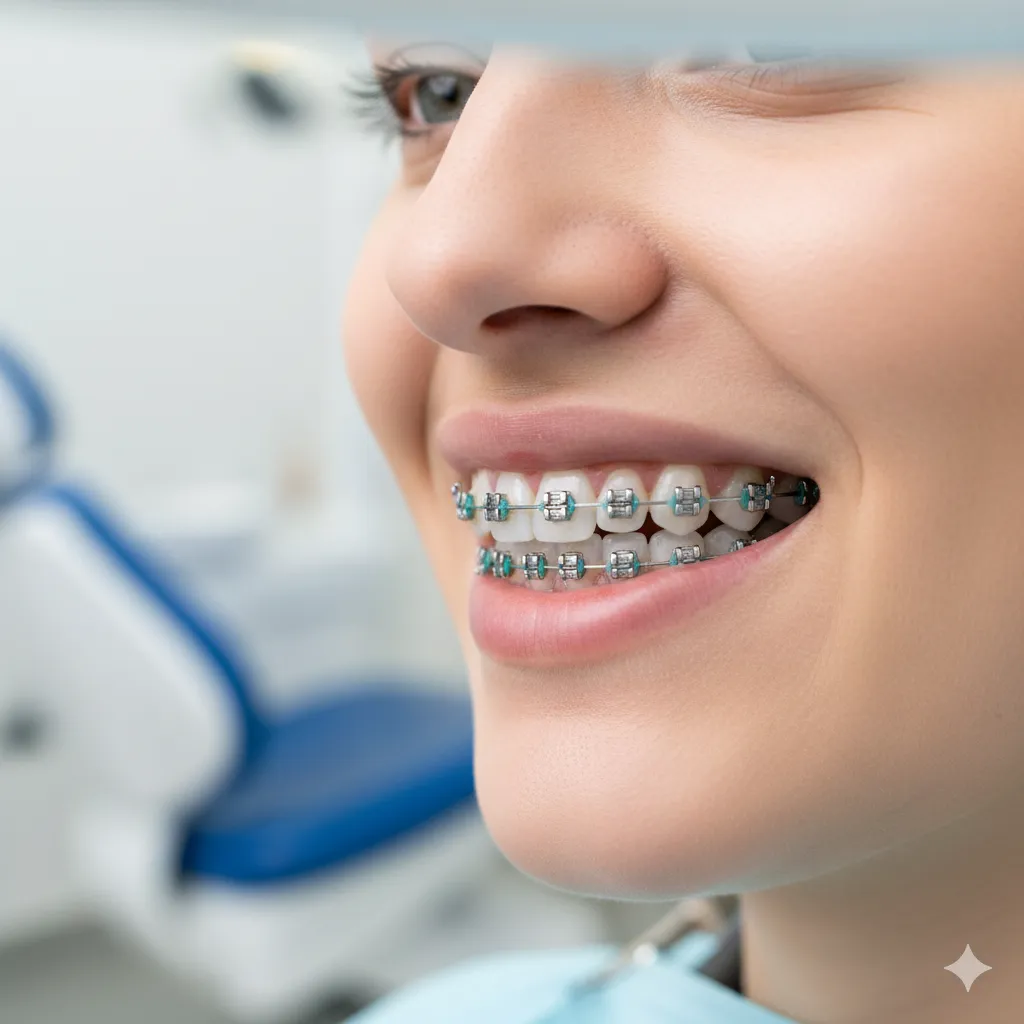
Brackets are small holders bonded to the teeth with a special adhesive during orthodontic treatment; through the archwires passing through them, they apply force to move the teeth into the correct position. This system is called fixed orthodontic treatment. Types include metal, ceramic, sapphire, self-ligating and lingual brackets placed on the inner surface of the teeth.
- Metal brackets are durable; ceramic and sapphire brackets are less noticeable.
- Self-ligating brackets use no elastics and create less friction.
- Lingual brackets are invisible from outside but harder to clean.
- Hard, sticky and hard-shelled foods should be avoided.
- Using an interdental brush and attending regular check-ups are important.
What Are Brackets? Brackets are small holders bonded to the teeth with a special adhesive during orthodontic treatment; through the wires passing over them (archwires), they apply force to the teeth to move them into the correct position. In dentistry, this system is generally called “fixed orthodontic treatment”.
Brackets balance the load on the teeth and transmit the pressure created by the wires to the tooth roots in a controlled way.
What Types of Brackets Are There?
With advances in technology, we are no longer limited to metal braces. Different options are available depending on the patient’s aesthetic concerns, budget and tooth structure:
1. Metal Brackets (Traditional Brackets)
The most common and oldest method. They are made of stainless steel.
-
Advantages: They are very durable, have a low risk of breaking and are usually the most economical option. Treatment progresses quite quickly.
-
Disadvantages: They create a noticeable metal appearance on the teeth.
2. Ceramic (Clear) Brackets
Preferred by adults and teenagers with strong aesthetic concerns. They are made of tooth-colored or fully transparent material.
-
Advantages: They are much less noticeable from the outside than metal brackets.
-
Disadvantages: They are somewhat more fragile than metal ones and cost a little more.
3. Sapphire (Ice) Brackets
Fully transparent brackets with a crystal structure. Because they reflect the natural color of the tooth, they are ideal for those looking for “invisible braces”.
-
Advantages: They resist staining and are the top-tier option aesthetically.
4. Self-Ligating (Damon) Brackets
In this system, no elastics are used to hold the wire to the bracket; the bracket itself has a special clip mechanism.
-
Advantages: Because there is less friction, the teeth move faster. Appointment intervals are longer and they are easier to clean.
-
Disadvantages: They cost more than other methods.
5. Lingual Brackets (Invisible Braces)
A method in which the brackets are attached not to the front surface of the teeth but to the inner (tongue-side) surface.
-
Advantages: They are completely invisible from the outside.
-
Disadvantages: Because they can restrict the tongue’s range of movement, they may make speaking difficult at first, and they are harder to clean.
What to Keep in Mind During Bracket Treatment
Once brackets are fitted, oral hygiene becomes more critical than ever. During treatment, pay attention to the following:
-
Diet: Hard (apples, quince), sticky (gum, caramel) and hard-shelled (nuts) foods should be avoided. Such foods can cause brackets to come off or wires to bend.
-
Oral Hygiene: Interdental brushes and orthodontic toothbrushes should be used. If food debris that collects around the brackets is not cleaned, it can lead to tooth decay and gum inflammation.
-
Regular Check-Ups: Keeping the appointments set by your orthodontist is essential for treatment to finish within the expected time.
Which Bracket Is Right for You?
When choosing brackets, your doctor assesses the condition of your teeth, your jaw structure and your expectations. If you want very fast results, metal or self-ligating brackets may be more suitable; if you say “I don’t want my braces to show”, ceramic or lingual systems may suit you better.
Remember: Whatever type of bracket is chosen, the success of treatment is directly proportional to your orthodontist’s experience and your compliance with the treatment rules.
At Optimadent, in Bağlarbaşı, Üsküdar, at the heart of Istanbul, we offer the orthodontic solutions best suited to you with our expert team. Book your appointment now to achieve the smile of your dreams!